What follows is my provisional translation (in other words, not official or authorized; see here for more) of a Tablet of Bahá’u’lláh to Khadíjih Kháḍi‘í (Khazei), the sister of Buyúk Áqá (see here for a Tablet of ‘Abdu’l-Bahá written for Buyúk Áqá). My provisional translation of this Tablet reflects a composite of two sources: a version of this Tablet that seems to be in the handwriting of Bahá’u’lláh, which was my main source (kindly supplied to me by Shidan Ashraf, the great-grandnephew of Khadíjih; see here), and another version that appears in a collection of manuscripts held at the British Library (Or15715, p. 201; see here). There is yet another version published in Faramarz Ashraf, Yárán-i-Qazvín, Munjadhibán-i-Jamál-i-Mubín, pp. 535–36 that contains textual errors.
The woman for whom this Tablet was revealed, Khadíjih Khánum, went blind at the age of about five or six due to smallpox or a similar illness. Bahá’u’lláh alludes to her condition in this Tablet, where He says, “thou hast not been afflicted with beholding the repudiators, the impious, and the deniers, meaning the divines of the age.”
The photograph of Khadíjih Khánum below was kindly provided to me by Shidan Ashraf.
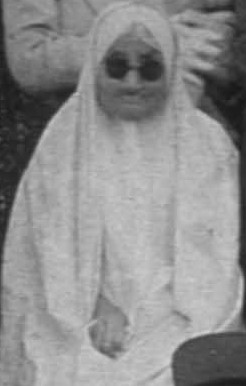 Khadíjih Khánum, for whom this Tablet was revealed.
* * *
Q [Qazvin]
To the handmaid of God, Khadíjih—upon her be the Glory of God—the wife of Áqá ‘Alí who had requested [this Tablet][1]
In My Name, the Compassionate, the Generous[2]
O Khadíjih, upon thee rest My glory! O My handmaid, upon thee be My bounty! Thou wast remembered before this Wronged One, and He now mentioneth thee with these sublime words, which have no equal or peer. By the righteousness of God! Every servant and handmaid who attaineth this Most Great Bounty hath ever been and continueth to be in My sight. Praised be God, thou hast not been afflicted with beholding the repudiators, the impious, and the deniers, meaning the divines of the age. Such is the case in one regard, but greater than this is that thou hast recognized God and received this most sublime, this most holy, this most glorious Tablet. From the chalice of these words, drink the waters of everlasting life, and God, magnified be His glory, shall proclaim, “Blessed art thou, O my handmaid!”
Thus hath the Bounty[3] of revelation spread His signs, and the Point of creation manifested His banners.
May conspicuous glory, shining from the horizon of this most exalted habitation, rest upon thee, and also on every handmaid who hath heard and exclaimed, “Praise be to Thee, O Lord of the world!”, and “Thanks be to Thee, O Desire of every understanding heart!”
========
[1] The translation of this line is based on the British Library manuscript. It is absent from the manuscript apparently in the handwriting of Bahá’u’lláh. Yet another version in Yárán-i-Qazvín, Munjadhibán-i-Jamál-i-Mubín, p. 535—which according to the author, Faramarz Ashraf, was copied from the original Tablet—has amatu’lláhu’l-munjadhibih, Khadíjih Khánum, ‘alayhá bahá’u’l-abhá (“[to] the attracted handmaid of God, Khadíjih Khánum, upon her be the Glory of the All-Glorious”). This version of the Tablet also has the full name of its destination as Qazvin, while in the British Library manuscript it has been abbreviated with the letter qáf (ق). My translation of that part reflects the latter version.
[2] The translation of this line is based on the manuscript apparently in the handwriting of Bahá’u’lláh. The British Library manuscript has bismi’l-mushfiq va bismi’l-karím (“In My Name, the Compassionate, and in My Name, the Generous”), which strikes me as uncharacteristic of Bahá’u’lláh’s style.
[3] Originally faḍl (فضل), per the manuscript apparently in the handwriting of Bahá’u’lláh. The British Library manuscript has فصل , which as a noun would presumably be fuṣal (فُصَل), the plural of faṣl (“chapter”), in which case this clause would mean something like: “Thus have the chapters of revelation spread their verses…” However, this reading seems unlikely to me because, as a plural noun, fuṣal would be grammatically inconsistent with the singular hi ( هِ ) attached to áyátihí (آیاته), meaning “its signs” or “its verses.”
A typescript of the original Persian and Arabic text of this Tablet appears below (all punctuation and short vowel marks mine).
 Adib Masumian